

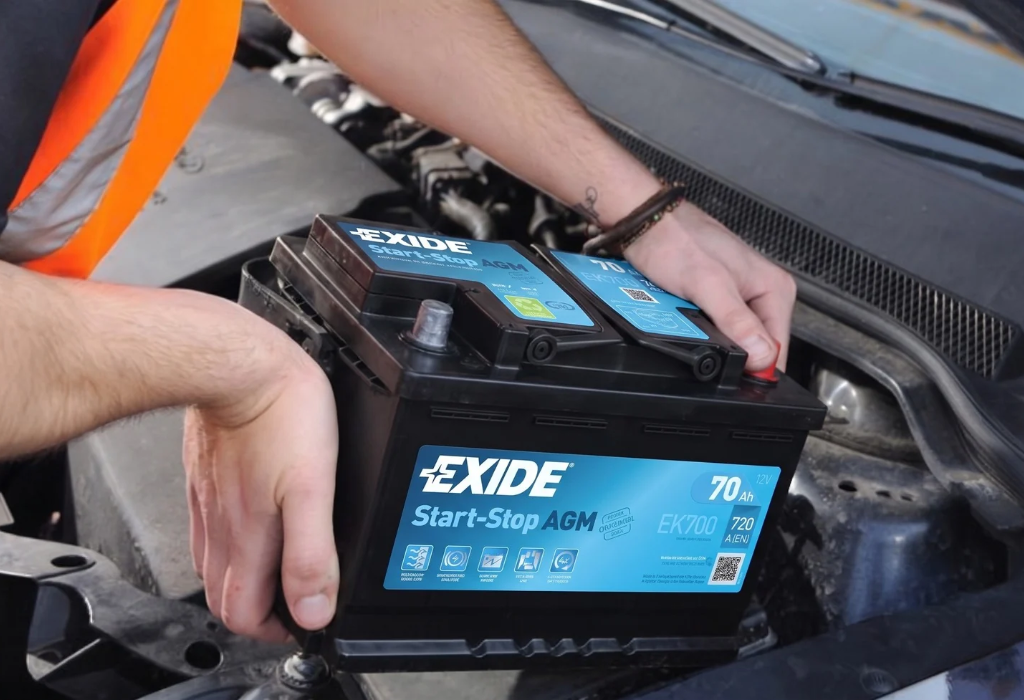
Confused by car battery ratings? Types, Specs, and what Ah, CCA, and voltage actually mean can be confusing. Learn the key differences between AGM, EFB, and Flooded Batteries in our Ultimate Guide To Car Batteries in Ireland.
Few sounds induce more dread than turning the key or pushing the start button only to hear a faint click and silence. Your car battery is the electrical heartbeat of your vehicle, yet most drivers don’t think about it until it leaves them stranded in a cold parking lot.
Modern vehicles demand far more electrical power than cars did a decade ago. Between touchscreen infotainment systems, heated seats, collision sensors, and fuel-saving Start-Stop engines, choosing the right replacement battery is critical.
In This Guide
- The Core Types of Car Batteries: Standard Flooded (SLI), EFB, AGM, and Lithium-ion
- Decoding the Specs: What Voltage, CCA, and Ah mean for your engine
- Matching Specs to Driving Needs: Why bigger isn’t always better
- How to Pick the Right Battery for Your Car
- Frequently Asked Questions (FAQs)
1. The Major Types of Car Batteries
Not all 12-volt car batteries are built the same way. Installing the wrong chemistry can lead to premature failure, alternator strain, or onboard computer errors.
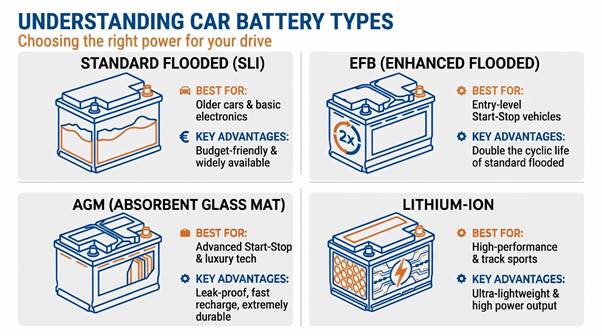
Standard Flooded (Wet Cell / SLI)
Standard flooded lead-acid batteries have powered automobiles for generations. They contain liquid electrolyte (a mixture of sulfuric acid and water) surrounding lead plates. They are often designated as SLI (Starting, Lighting, Ignition).
- Pros: Most affordable option; reliable starting power for conventional vehicles.
- Cons: Sensitive to deep discharging; shorter cycle life; cannot handle the repeated cycling demanded by modern Start-Stop systems.
EFB (Enhanced Flooded Battery)
An EFB is an upgraded version of the wet-cell battery. It uses a polyfleece scrim applied to the positive plate surface, stabilizing the active material and doubling the cyclic endurance compared to traditional flooded units.
- Pros: Handles partial state-of-charge conditions better than standard flooded; cost-effective alternative for vehicles with basic automatic engine shut-off systems.
- Cons: Less resilient to deep discharge and high electrical loads than AGM batteries.
AGM (Absorbent Glass Mat)
In an AGM battery, the liquid electrolyte is absorbed into ultra-fine fiberglass mats compressed between the lead plates. There is no free-flowing acid inside.
- Pros: Completely sealed, spill-proof, and highly resistant to road vibration; recharges up to 5 times faster than standard batteries; withstands repeated deep discharges from advanced Start-Stop systems and regenerative braking.
- Cons: More expensive than flooded batteries; sensitive to high engine bay heat and overcharging.
- Important Rule: If your car rolled off the factory floor with an AGM battery, never downgrade to an EFB or standard flooded battery. Doing so can trigger dashboard warning lights and destroy the battery within months.
Lithium-Ion (LiFePO4)
Primarily found in exotic sports cars, track-oriented vehicles, and specific modern luxury performance models, lithium-ion starter batteries offer immense energy density.
- Pros: Weighed up to 70% less than equivalent lead-acid units; exceptional lifespan; flat discharge curve.
- Cons: Significantly higher cost; requires dedicated battery management systems (BMS) and specialized chargers.
2. Decoding Battery Ratings: Voltage, Ah, and CCA
The label on top of a car battery can look like a wall of acronyms. Here is what those numbers tell you.
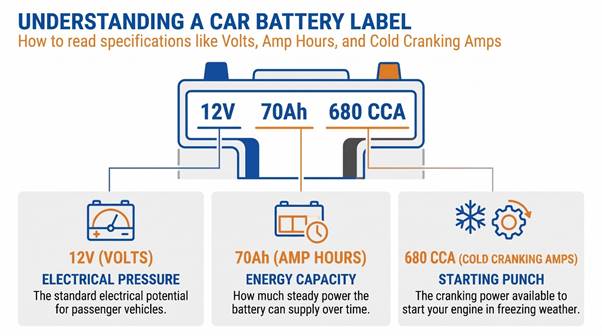
Voltage (V): Electrical Pressure
Voltage measures the electrical potential of the battery. Passenger vehicles run on a nominal 12-volt electrical system (commercial trucks and heavy equipment typically use 24V).
A healthy 12V battery should measure:
- 12.6V to 12.7V: Fully charged at rest (engine off).
- 12.2V to 12.4V: 50% to 75% charged; needs driving or charging.
- Below 12.0V: Discharged; engine cranking issues likely.
- 13.7V to 14.7V: Normal operating range while the engine is running (alternator charging).
CCA (Cold Cranking Amps): Starting Punch
Cold Cranking Amps measure a battery’s ability to turn over a cold engine.
The Technical Definition: CCA is the number of amperes a 12V battery can deliver at 0°F (-18°C) for 30 continuous seconds while maintaining a voltage of at least 7.2 volts.
Engine oil thickens when freezing, creating severe mechanical drag. At the same time, battery chemical reactions slow down drastically. A higher CCA rating ensures the battery has enough sheer cranking power to fire up cold pistons and overcome thick oil.
- Compact gas engines: Often require 400 to 500 CCA.
- Large V8 engines and diesels: Often demand 700 to 900+ CCA due to higher compression ratios and glow-plug requirements.
(Note: Don’t confuse CCA with CA or Cranking Amps, which is tested at a warmer 32°F/0°C and yields a higher, less demanding number.)
Ah (Ampere-Hours): Reserve Capacity
While CCA measures peak short-term power, Ah (Amp Hours) measures sustained endurance.
The Technical Definition: Ah measures how much steady current a battery can supply over a 20-hour period at room temperature before the voltage drops to 10.5V.
For example, a 70 Ah battery can deliver:

A higher Ah rating provides a larger buffer for running auxiliary power: dashcams in parking mode, GPS units, headlights accidentally left on, or keeping vehicle modules alive during extended parking periods.
3. How to Choose the Right Battery for Your Car
When it is time for a replacement, follow this checklist before making a purchase:
- Verify Physical Group Size: Batteries are standardized into group sizes (e.g., Group 35, 48/H6, 94R/H7). The dimensions (length, width, height) and terminal layout (positive on left vs. right) must match your battery tray.
- Match or Exceed Factory Specs: Check your vehicle manual for the minimum required CCA and Ah ratings. Exceeding factory ratings slightly will not hurt your vehicle, but falling below them can cause slow cranking and computer voltage drops.
- Check the Chemistry: Always replace like-with-like or upgrade. You can safely replace a Flooded battery with an EFB or AGM, but never replace an AGM battery with a standard Flooded battery.
- Account for Battery Registration/Coding: Many European and late-model vehicles use a Battery Management System (BMS) that monitors battery age and degradation. When installing a new battery, the vehicle’s computer must be reset with a diagnostic scanner to adjust its alternator charge rate.
Frequently Asked Questions
Can a battery have too much CCA for my car?
No. Your car’s starter motor only draws the amperage it requires. Installing a battery with 800 CCA in a car that only calls for 550 CCA will not damage the electrical system; it simply provides surplus starting power in winter conditions.
How long does a typical car battery last?
The average automotive battery lasts between 3 to 5 years. Extreme temperature swings (especially scorching summer heat, which accelerates plate corrosion and fluid evaporation) can reduce lifespan down to 2 or 3 years.
What are the earliest warning signs of a dying battery?
Common indicators include:
- Slower engine crank speed when starting in the morning
- Headlights dimming momentarily when the engine idles
- Click sounds from the starter relay
- Dashboard battery warning lights or Start-Stop unavailable messages
- A rotten egg / sulfur odor indicating an overcharged or off-gassing battery
Can I upgrade from a standard flooded battery to an AGM?
Yes. Upgrading from a standard flooded battery to an AGM is a reliable way to increase durability, especially if you live in extreme climates, have added aftermarket sound systems, or take frequent short trips that stress standard batteries. Just verify that your vehicle’s alternator charging profile is compatible with AGM charging voltages.





Leave a Reply