

Have you ever wondered how your car transitions power from a spinning engine to stationary wheels without stalling? The secret lies entirely within your car’s clutch system.
Whether you drive a manual or want to understand what goes on beneath the gearbox, knowing what a clutch does and how it functions can help you spot early signs of wear and save money on major repairs.
What Does a Clutch Do?
At its most basic level, a car clutch is a mechanical link that connects and disconnects the engine’s rotating power from the gearbox and wheels.
Because your engine spins continuously when turned on, you need a way to temporarily break that connection so you can stop the car without killing the engine, or smoothly change gears while moving. When engaged, the engine’s rotational energy transfers through the gearbox, onto the drive-shafts, and eventually turns the wheels.
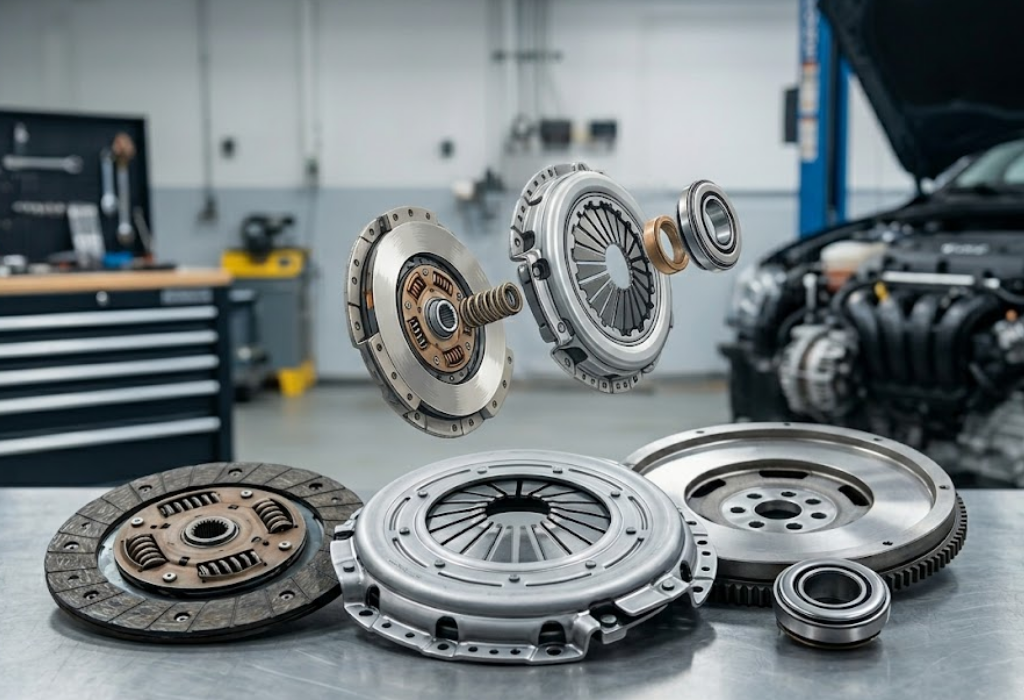
The 3 Core Clutch Kit Components
A standard manual car clutch relies on three primary components working tightly together inside the bell housing:
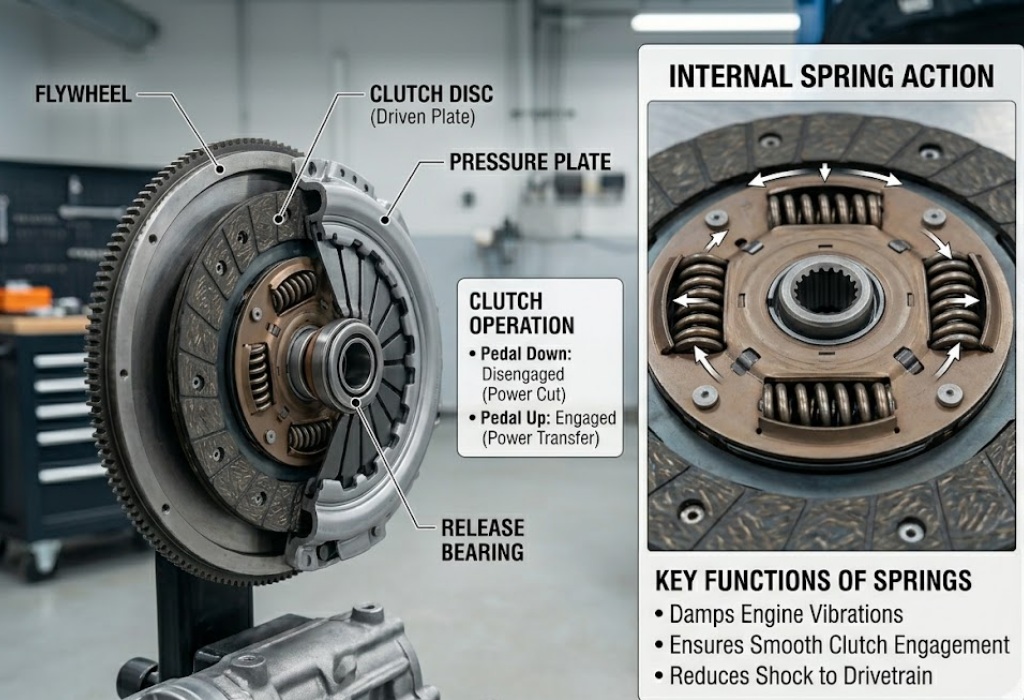
The Clutch Disc (Driven Plate): A heavy-duty friction plate splined directly to the gearbox input shaft. It sits right between the engine flywheel and the pressure plate.
The Pressure Plate: A spring-loaded clamp bolted directly to the engine’s flywheel. Its job is to firmly squash the clutch disc against the flywheel so they spin at the exact same speed
The Release Bearing (Throw-out Bearing): The component operated by a clutch fork that physically pushes against the pressure plate’s diaphragm springs when you step on the pedal.
How it Works: Pressing vs. Releasing the Pedal
Understanding the mechanical dance inside the gearbox comes down to what happens when you move your left foot:
1. Clutch Pedal Fully Up (Driving Normally)
When your foot is completely off the pedal, the clutch is engaged. The high-pressure springs inside the pressure plate clamp the clutch disc tightly against the engine’s flywheel. Friction locks them all together, allowing 100% of the engine’s rotational power to flow straight into the transmission and drive the wheels forward.
2. Clutch Pedal Pressed Down (Changing Gears)
When you press the clutch pedal down, you disengage the system. A mechanical linkage or hydraulic line moves a fork inside the gearbox, forcing the release bearing against the center of the pressure plate. This action releases the clamping force on the clutch disc.
With the pressure gone, the clutch disc stops spinning alongside the engine, giving you a brief window to smoothly shift into a different gear without grinding the transmission.
Warning Signs: What is a Slipping Clutch?
Like brake pads, the friction material on a clutch disc naturally wears down over time. When it gets too thin, the pressure plate can no longer grip the flywheel tightly enough, resulting in a slipping clutch.
Common Clutch Slipping Symptoms:
High RPM, Low Acceleration: When accelerating, your engine speed (RPM) shoots up rapidly, but the vehicle speeds up incredibly slowly.
A Burning Smell: A slipping clutch creates intense friction and heat, resulting in a distinct, pungent burning odor.
Soft or Spongy Pedal: The clutch pedal might feel unusually loose or require very little effort to push to the floor.
The Verdict: Unfortunately, there is no quick-fix or adjustment for a worn-out clutch plate; the entire assembly will need to be replaced.
When it comes to replacement, we always recommend purchasing a complete clutch kit rather than replacing individual parts. Because taking apart the gearbox requires significant labor time, replacing all three core components (disc, pressure plate, and bearing) at the same time ensures you won’t have to pay to reopen the transmission a few months down the line.
Frequently Asked Questions About Clutches
What is a clutch for a car?
A car clutch is a mechanical link located between the engine and the gearbox. Because your car’s engine spins continuously when turned on, the wheels cannot be permanently connected to it. The clutch allows you to temporarily disconnect the engine’s power from the transmission so you can shift gears, bring the vehicle to a complete stop, or take off from a standstill without stalling the engine.
How much does a clutch cost to replace? / How much does it cost to replace a clutch in a car?
The total cost to replace a clutch can vary significantly based on your car’s make and model. Because the mechanic has to remove the entire gearbox to access it, it is a very labor-intensive job taking 4 to 6 hours on average.
- Small/Economy Cars: Typically cost between €400 to €700 / £350 to £600.
- Mid-Sized/Family Cars: Typically cost between €600 to €900 / £500 to £750.
- Premium/Diesel/SUV Cars: Often cost between €900 to €1,500+ / £750 to £1,200+.
- Note: If your car uses a Dual-Mass Flywheel (DMF)—which is incredibly common on modern diesel and performance cars—replacing it at the same time will usually add an extra €300 to €600 (£250 to £500) to the final bill.
Can I still drive if my clutch is gone?
No. If your clutch is completely “gone” or has failed entirely, you should not attempt to drive the vehicle. Without a functioning clutch, you will either be unable to force the car into gear, or the clutch will slip so badly that the engine’s power won’t reach the wheels, leaving you stuck. If you notice early warning signs like severe slipping or a spongy pedal, you should only drive the car a short distance directly to a repair garage, as a total failure can happen suddenly and leave you stranded in dangerous traffic.
How long does a car clutch typically last?
On average, a standard car clutch lasts between 60,000 to 100,000 miles. However, this depends heavily on driving style—frequent stop-and-go city driving or “riding the clutch” can cause it to wear out much faster.
Can I drive with a slipping clutch?
You can drive it for a very short distance to get to a repair shop, but it is not safe to continue driving long-term. As the slip gets worse, your car will lose the ability to accelerate entirely, potentially leaving you stranded in traffic.
Why does my clutch pedal feel vibration?
A vibrating clutch pedal is usually a sign that the clutch disc is unevenly wearing, the pressure plate diaphragm springs are damaged, or the engine flywheel is warped. It should be inspected by a mechanic as soon as possible.
What is the difference between a 2-piece and 3-piece clutch kit?
A 2-piece clutch kit typically includes just the clutch disc and the pressure plate. A 3-piece clutch kit includes the disc, pressure plate, and the crucial release bearing. We always recommend installing a 3-piece kit, as replacing the bearing later requires pulling the entire gearbox apart all over again.
What does it mean to “ride the clutch”?
Riding the clutch means keeping your left foot resting lightly on the clutch pedal while driving, instead of moving it to the footrest. Even slight pressure can cause the pressure plate to partially release its grip, creating constant, unnecessary friction that burns out your clutch disc prematurely.
Why does my clutch make a squealing noise when I press the pedal?
If you hear a distinct squealing or whining noise only when you depress the clutch pedal, your release bearing (throw-out bearing) is likely failing. When the bearing wears out, the metal-on-metal friction creates a sharp noise that will progressively get worse until the bearing seizes completely.
Should I replace the flywheel when changing a clutch?
It is highly recommended to at least resurface the flywheel, if not replace it entirely, during a clutch change. A worn flywheel often develops heat spots, grooves, or cracks from the old clutch disc. Putting a brand-new clutch disc onto an un-resurfaced, warped flywheel will cause the new clutch to slip or chatter immediately.


Leave a Reply