

Reviewed by the MicksGarage technical team
Quick answer: Brake fluid should be changed every 2 years on most cars, or at the interval in your handbook. It absorbs water from the air over time, which lowers its boiling point and can lead to a soft, spongy pedal or brake fade. Most cars use DOT 4. A full change usually needs around 1 litre of fluid, which costs from about €9 at MicksGarage.
| At a glance | |
|---|---|
| How often | Every 2 years (check your handbook) |
| Most common type | DOT 4 |
| Fluid needed | Around 1 litre for a full flush on most cars |
| Fluid cost | From about €7 for 500ml or €9 for 1 litre |
| DIY difficulty | Moderate, and easier with a helper or a one-person bleed kit |
Why does brake fluid need changing?
Brake fluid is one of the most neglected parts of a car. Most brake fluids are hygroscopic, which means they naturally absorb moisture from the air. Ireland’s damp climate doesn’t help.
When fresh, brake fluid is virtually incompressible, which is what gives you a firm pedal. As it absorbs water, its boiling point drops. Under heavy braking, such as a long descent or towing, the fluid in the calipers can boil and form gas bubbles. Gas compresses, so the pedal goes soft and long, and in extreme cases you have to pump it to get any braking at all. Water in the fluid also corrodes brake lines, calipers and ABS parts from the inside.
How often should brake fluid be changed?
Most car makers recommend changing brake fluid every 2 years, whatever the mileage. Some newer cars allow 3 years, so always follow your handbook or service schedule. Change it sooner if a test shows high water content, if the fluid has turned dark, or if you tow or drive in hilly areas a lot.
Signs your brake fluid needs changing
| Sign | What it can mean |
|---|---|
| Soft or spongy brake pedal | Moisture or air in the fluid |
| Pedal travels further than usual or sinks | Old fluid, air in the system or a leak, so get it checked now |
| Dark brown or murky fluid in the reservoir | Old, contaminated fluid (fresh fluid is clear to light amber) |
| Brake warning light on | Often a low fluid level, which can also mean worn pads or a leak |
| Brakes fade on long descents | Fluid boiling because of a lowered boiling point |
| More than 2 years since the last change | Due a change, even with no symptoms |
A brake fluid tester pen measures water content in seconds. Fluid with around 3% water or more should be changed. If the warning light is on, also check your pads: see our guide on how to check brake pads and discs for wear.
DOT 3 vs DOT 4 vs DOT 5.1: which brake fluid do I need?
Always use the fluid type printed on your brake fluid reservoir cap or in your handbook. Most modern cars use DOT 4. The DOT rating sets a minimum boiling point for fresh (dry) fluid and for fluid that has absorbed water (wet):
| Type | Base | Min. dry boiling point | Min. wet boiling point | Used in |
|---|---|---|---|---|
| DOT 3 | Glycol | 205°C | 140°C | Older and some American or Asian cars |
| DOT 4 | Glycol | 230°C | 155°C | Most modern European cars |
| DOT 4 ESP / Class 6 | Glycol, low viscosity | Meets DOT 4 | Meets DOT 4 | Many newer cars with ABS and ESP |
| DOT 5.1 | Glycol | 260°C | 180°C | Performance cars, or as an upgrade from DOT 4 |
| DOT 5 | Silicone | 260°C | 180°C | Specialist use only: don’t mix with the others |
| LHM (green mineral) | Mineral oil | n/a | n/a | Older Citroën hydropneumatic systems only |
DOT 3, DOT 4 and DOT 5.1 are all glycol-based and compatible, so you can usually upgrade from DOT 3 to DOT 4, or from DOT 4 to DOT 5.1. Never put DOT 5 (silicone) or LHM mineral fluid into a system designed for glycol fluid, or the other way round, as it can damage the seals.
Brake fluid at MicksGarage
We stock brake fluid from leading brands, in 250ml to 5-litre packs:
| Brake fluid | Type | Price |
|---|---|---|
| APEC DOT 4, 1 litre | DOT 4 | €8.99 |
| Bosch DOT 4, 1 litre | DOT 4 | €12.99 |
| Brembo DOT 4, 1 litre | DOT 4 | €12.99 |
| Bosch ENV6 Synthetic, 1 litre | DOT 4 low viscosity (Class 6) | €19.99 |
| APEC DOT 4 ESP, 1 litre | DOT 4 ESP | €12.99 |
| APEC DOT 5.1, 1 litre | DOT 5.1 | €17.99 |
| Bosch DOT 3, 1 litre | DOT 3 | €13.99 |
| Total LHM Plus, 1 litre | Mineral (Citroën) | €11.99 |
Prices correct at time of writing. Browse all brake fluid, or shop by brand: Bosch, Brembo, APEC or Febi Bilstein.
How much brake fluid do I need?
For a full flush, around 1 litre is enough for most cars. Larger cars, vans and cars with complex ABS systems may need a little more. For a top-up, a 250ml or 500ml bottle is plenty. Brake fluid absorbs moisture once opened, so buy the size you need and keep the cap tightly closed.
How to change brake fluid: step by step
Changing brake fluid means pushing old fluid out through the bleed nipple on each brake while topping up with fresh fluid at the reservoir. If you’re not confident working on brakes, have a garage do it.
You will need
- The correct new brake fluid (usually 1 litre)
- A ring spanner to fit the bleed nipples
- A length of clear tube and a bottle to catch the old fluid
- A helper, or a one-person brake bleeding kit
- A jack and axle stands, or ramps, if you need to remove the wheels
- Gloves, eye protection and rags. Brake fluid damages paint, so wipe up spills straight away.
Steps
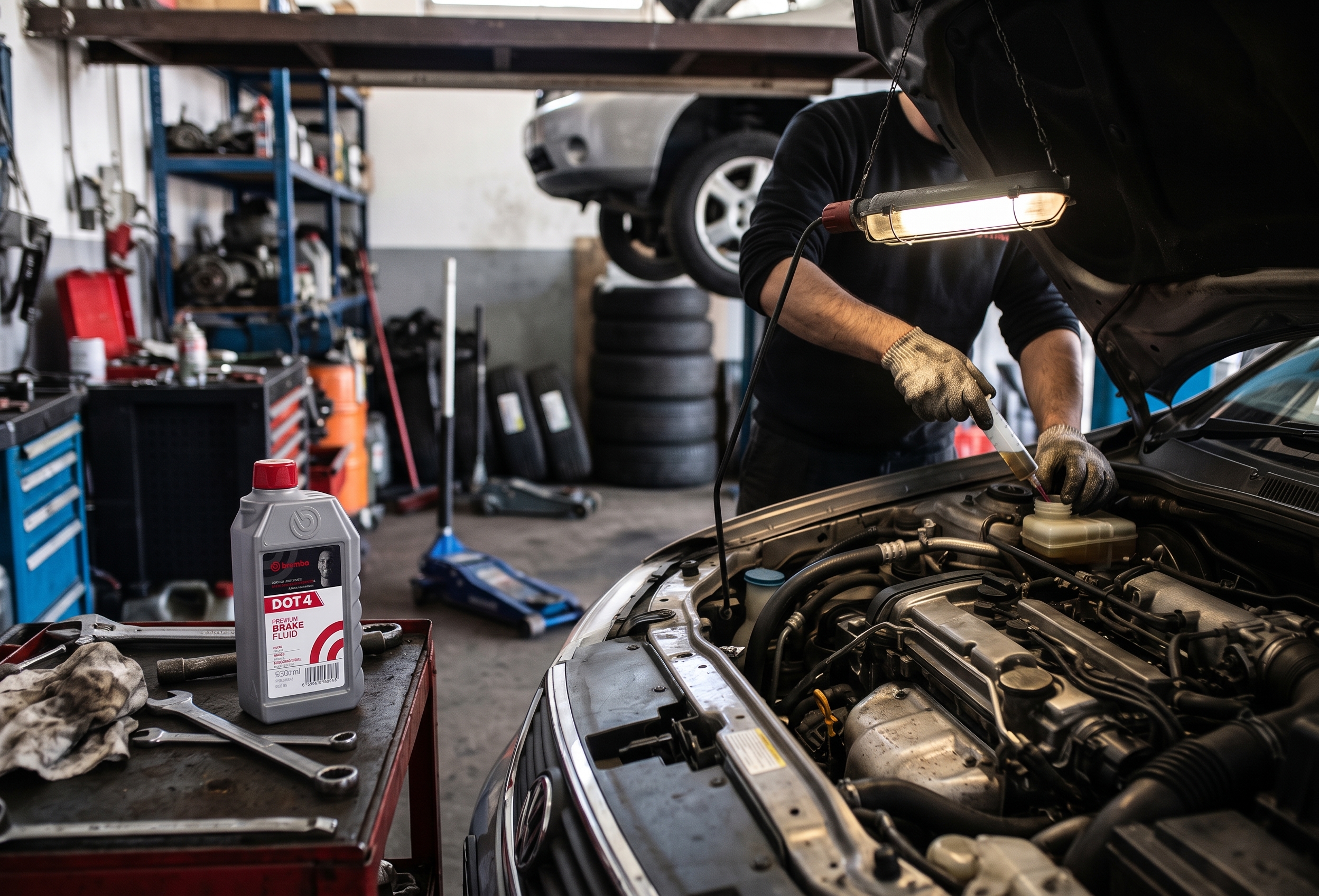
- Remove the old fluid from the reservoir with a syringe or turkey baster, and refill it with fresh fluid. Don’t let it drop below MIN at any point, or you’ll draw air into the system.
- Start at the wheel furthest from the master cylinder. On most right-hand-drive cars that’s the rear left, then the rear right, front left and front right. Some ABS systems need a specific order, so check your manual.
- Fit the clear tube to the bleed nipple and put the other end in the bottle.
- Open the nipple about a quarter turn while your helper presses the brake pedal slowly to the floor and holds it. Close the nipple, then have them release the pedal.
- Repeat until clean, bubble-free fluid comes through the tube, topping up the reservoir as you go.
- Move to the next wheel and repeat.
- Top up to MAX, refit the cap and check the pedal is firm before you drive. Test the brakes at low speed first.
Want to see it done? Here’s how we changed the brake fluid on our Golf GTI project car. For a detailed bleeding walkthrough, see Project GTi: How to Bleed Your Brakes.
How much does a brake fluid change cost?
If you do it yourself, the main cost is the fluid: about €9–€20 for a litre of quality DOT 4. A garage will charge labour on top, and the price varies by garage and car, so ask for a fitted quote. Many garages include a brake fluid change in a major service every 2 years.
Brake fluid FAQs
Can I just top up brake fluid instead of changing it?
Topping up adds fresh fluid, but it doesn’t remove the water already in the system, so it’s no substitute for a full change every 2 years. If the level keeps dropping, have the brakes checked: it usually means worn pads or a leak.
Can I mix DOT 3 and DOT 4?
Yes. They’re both glycol-based and compatible, but the mix only performs as well as the lower-rated fluid. It’s best to flush and refill with the fluid your car specifies. Never mix DOT 5 (silicone) with any other type.
Is it safe to drive with old brake fluid?
Old fluid can still work in normal driving, but its lower boiling point makes brake fade more likely under hard braking, and the water inside causes corrosion. If the pedal feels soft, get it checked straight away.
What colour should brake fluid be?
New glycol brake fluid is clear to light amber. As it ages and absorbs moisture, it turns darker brown. Dark fluid is a sign it’s due a change.
Does brake fluid expire in the bottle?
An unopened, sealed bottle keeps well, but once opened the fluid starts absorbing moisture. Use it within a few months and keep the cap tight.
Time for fresh fluid? Shop our full brake fluid range, plus brake pads and brake discs for your car.

Leave a Reply